
- In the past five years, room rents in Belfast have risen by 53%, Newcastle by 52% and Cardiff by 50% - the highest increases across the UK's 20 biggest cities.
Over the past five years, steep rent rises across the UK have squeezed affordability, pushed people further from where they want to live, and changed household dynamics. Looking at how room rents have increased in major cities, it's clear that some have been worse affected than others, reports flatshare site SpareRoom.
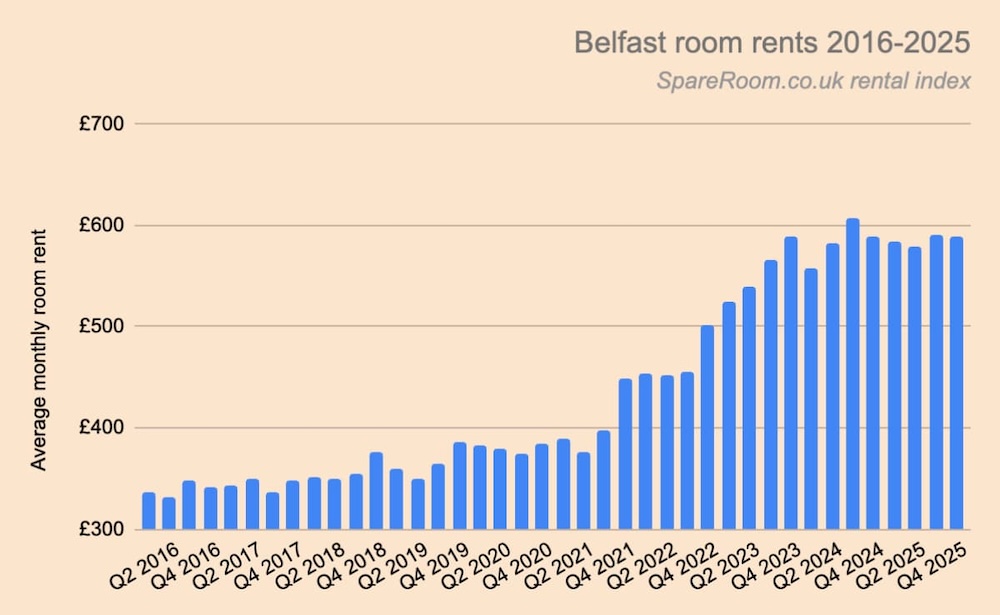
Out of the 20 biggest cities in the UK, Belfast has seen the steepest rent rises of all. Room rents here have increased by more than half (53%) in the five years to Q4 2025, meaning the average tenant is paying £2,460 per year in rent more today than they did in Q4 2020.
Close behind Belfast are Newcastle (+52%) and Cardiff (+50%). Rents in the Welsh capital hit a record high of £666 per month in Q4 20251.
Broadly speaking, rents in many cities, including London and Belfast, are now showing signs of stabilisation, but are still largely unaffordable because none have seen significant rent decreases.
But that's not the case in all cities. Liverpool saw room rents hit a record high of £555 per month in Q4 2025 and it has also seen the biggest year-on-year increase, of 5.5%.
Today, Bradford (£472) and Hull (£512) offer the cheapest monthly room rents across the top 20 cities but, year on year, rents in Hull are rising 4.5%.
Coventry (+25%) might have seen the smallest five-year rent rise of all the major cities, but rents here are still increasing 2% year on year - one of the highest increases across the 20 biggest cities. Manchester (-3.7%) and Edinburgh (-3.6%) have seen the biggest year-on-year rent drops but some of the highest five-year increases, upwards of 40%.
The table below ranks the UK's biggest cities by their five-year rent change, and also shows their year-on-year increases:
| UK's 20 biggest cities | Q4 2025 average monthly room rent | Q4 2024 average monthly room rent | Q4 2020 average monthly room rent | 1-year change | 5-year change | |
|---|---|---|---|---|---|---|
| 1 | Belfast | £589 | £589 | £384 | 0.0% | 53.2% |
| 2 | Newcastle | £605 | £615 | £399 | -1.6% | 51.7% |
| 3 | Cardiff | £666 | £664 | £444 | 0.3% | 49.9% |
| 4 | Glasgow | £690 | £695 | £478 | -0.7% | 44.5% |
| 5 | Manchester | £691 | £717 | £483 | -3.7% | 43.2% |
| 6 | Edinburgh | £778 | £807 | £552 | -3.6% | 41.0% |
| 7 | Derby | £585 | £574 | £415 | 1.9% | 40.9% |
| 8 | Liverpool | £555 | £526 | £398 | 5.5% | 39.5% |
| 8 | Southampton | £660 | £666 | £479 | -0.8% | 37.9% |
| 10 | Birmingham | £618 | £629 | £452 | -1.8% | 36.8% |
| 11 | London | £985 | £993 | £721 | -0.9% | 36.6% |
| 12 | Bristol | £737 | £737 | £552 | -0.1% | 33.6% |
| 13 | Hull | £512 | £490 | £386 | 4.5% | 32.6% |
| 14 | Bradford | £472 | £475 | £359 | -0.7% | 31.6% |
| 15 | Leicester | £566 | £563 | £436 | 0.4% | 29.6% |
| 16 | Brighton | £750 | £744 | £582 | 0.8% | 28.8% |
| 17 | Nottingham | £589 | £593 | £459 | -0.8% | 28.1% |
| 18 | Leeds | £565 | £576 | £445 | -2.0% | 26.9% |
| 19 | Sheffield | £521 | £528 | £412 | -1.3% | 26.5% |
| 20 | Coventry | £560 | £550 | £448 | 2.0% | 25.2% |
| UK excluding inner London | £670 | £664 | £494 | 0.9% | 35.6% | |
| Whole of UK | £749 | £745 | £580 | 0.5% | 29.0% |
The 10-year graph below shows how the trajectory of rent rises in Belfast were altered by the pandemic from around mid-2021:
Matt Hutchinson, director at flatshare site SpareRoom, comments: “Flatsharing has long afforded people the opportunity to live in cities, but disproportionate rent increases in recent years have created a barrier to urban living for those at the sharp end of the housing crisis. Affordability has been stretched to breaking point, and it's even changing the dynamics of shared households. Flatsharers are getting older as younger people are being priced out of the rental market altogether, and suburban housesharing is now increasingly common as more people are priced further out of cities too. It's not knowledge workers who suffer most, it's often the lowest-paid workers - including those in essential and key worker roles, hospitality and retail jobs - who keep our cities functioning.”