
As flatsharers are getting older - with spiralling living costs pushing home ownership and renting solo further out of reach - research by SpareRoom reveals it's not uncommon to find couples and children living in shared rentals today.
When Aeron Suarez's flatmate met the love of her life, her new partner moved into the home she and Aeron were renting together - a ground-floor garden flat in Lambeth - and two became three.

Fast forward to 2026 and three is now six, because the couple have since had three children and Aeron (pictured), a 38-year-old NHS nurse, is now an 'uncle' by proximity.
He told us: “By the time my flatmate eventually got married, we had already become like brother and sister, so we just kept on living together.”
When the couple had their first child, they all agreed to play their living arrangement by ear. When baby number two came along, Aeron said he seriously considered moving out, but the idea scared him. “I didn't want to live alone, and the cost would have been too high for a place I wasn't that keen on,” he explains.
And so he stayed. He says: “It is strange that I've lived with my friend for longer than her husband has! But we're very tight knit, like family. And our place is big enough for all of us. Because of the layout - my bedroom is right at the end of the house - I don't hear the children crying at night and I sleep really well.”
Aeron says he's only very rarely called on to help with childcare and he has a very different lifestyle to the couple he lives with. “I go out a lot for dinners and parties, and get home in the early hours. I'm not someone to rely on for school pickups but I will help out if I don't have plans. I'm very much a last-resort babysitter!”
Changing dynamics of flatsharing households
Due to the high cost of living, renters are living in flatshares for longer. A breakdown of SpareRoom user data by age shows that over 45s now make up 16% of the flatshare market, up from a tenth a decade ago, while those aged under 45 are in decline, as shown in the table below1.

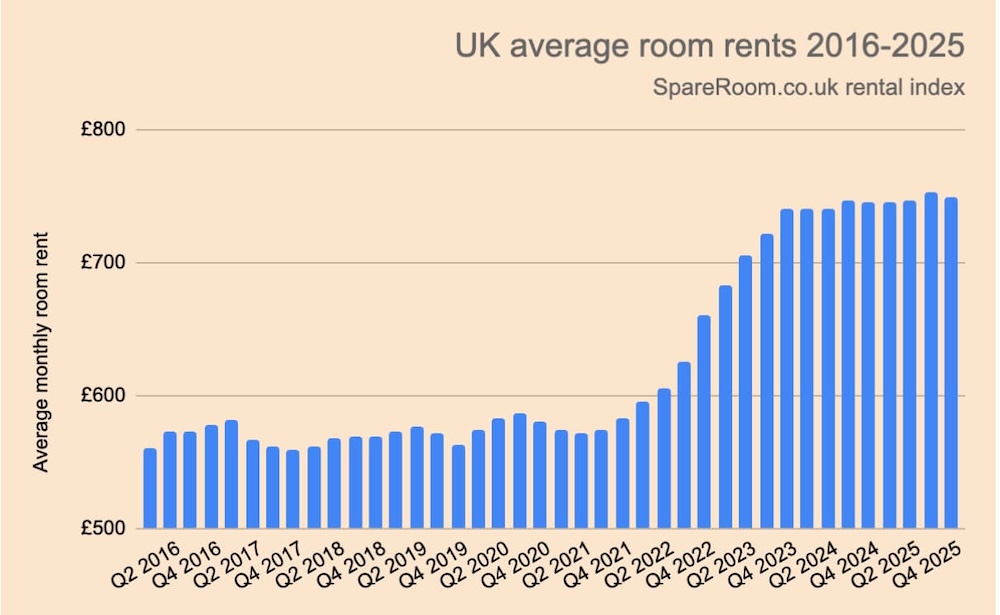
This is largely due to rising rents. Over the past five years, the average UK room rent has risen by 29% to £749 per month, with particularly steep rises seen in the two-year period after the pandemic lockdowns ended, fuelled by unusually high demand in the market2. But renters in many major cities have seen far higher increases, including Belfast, Newcastle and Cardiff where rents have risen by 50% or more in that same five-year period2.
Flatsharing is considerably cheaper than renting solo. The average UK monthly private rent in flats and maisonettes is now £1,334 per month, according to the ONS. This is 78% higher than renting an average room in a UK flatshare (£749 pm), a figure that also includes bills3
Prevalence of couples & children in flatshares
The knock-on effect of rising housing costs is that couples and children now commonly feature in flatshare households - more often than many might realise. Those typical life milestones, of finding a partner and moving into your own place together before starting a family, are now increasingly unattainable as budgets are squeezed.
In a January 2026 SpareRoom survey of 3,360 UK flatsharers, almost three in 10 (28%) reported couples living in their households.
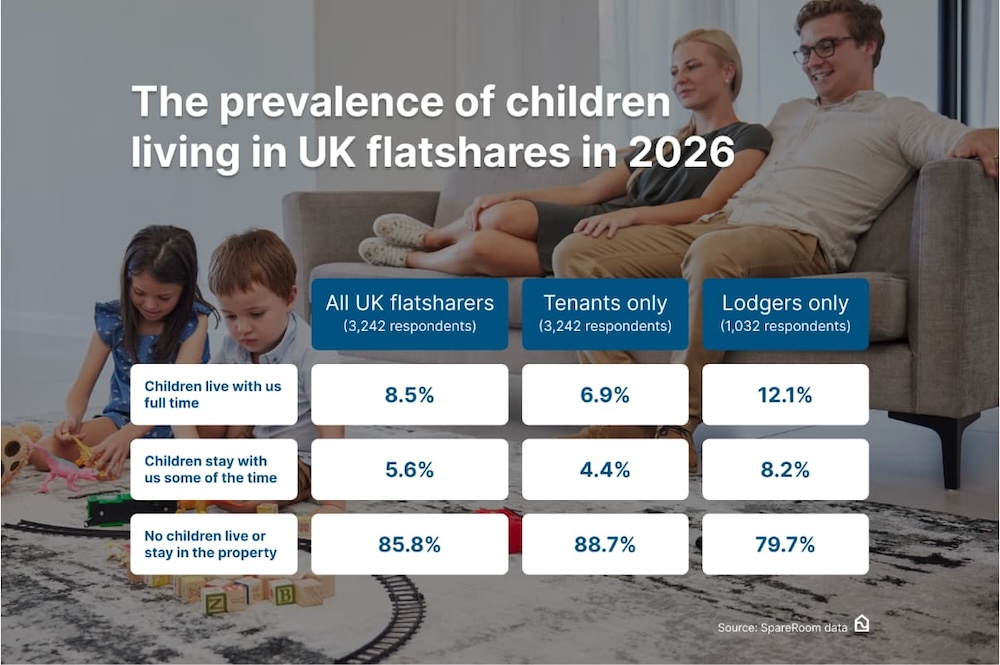
And, in a January 2026 SpareRoom survey of 3,242 UK flatsharers, around one in seven (14%) UK flatsharers reported living in households where children were present: 8.5% rented in households where children lived full time, and 5.6% rented in households where children stayed some of the time3.
Lodgers - who live with their landlords - were twice as likely as tenants to live in households where children were living or staying (20% vs 11%), as shown in the table below3.
Matt Hutchinson, director of flatshare site SpareRoom, comments: “Those traditional milestones - meeting someone, moving in to your own place together, buying a home, having kids - can get blown out the water when housing is unaffordable on an average wage. But, as the data shows, life doesn't stop because people can't afford to rent or buy a place of their own. The dynamics of shared renter households are being transformed as people keep moving forwards, even when faced with a housing affordability crisis.
“Shared households where children are present can take many different forms. There are the couples with understanding flatmates who have their first baby before they're able to afford to rent or buy a place of their own. There are the homeowning families renting spare rooms to lodgers. There are the single parents teaming up and renting a place together, helping each other out with childcare. There are the divorced or separated parents who've moved out of the family home and whose children stay for weekends only.
“You might expect to see more lodgers than tenants living in households with children. Families have been renting out spare rooms in their homes to make extra money for centuries. But the issue of children living in tenant houseshares full time looks to be happening under the radar, as we're not seeing children being mentioned in flatmate ads. This is a sign of the times and the knock-on effect of years of turbulence in the rental market.”